


Dealing with stubborn muscle pain that won’t go away? Dry needling might be the missing piece in your recovery.
At Affinity Wellness, dry needling is performed by specially trained physiotherapists who have completed post-graduate certification in this technique. It’s one of the most effective tools we have for treating deep muscle tension, trigger points, and chronic pain that hasn’t responded to other treatments.
No referral needed. Direct billing available. Book online today.
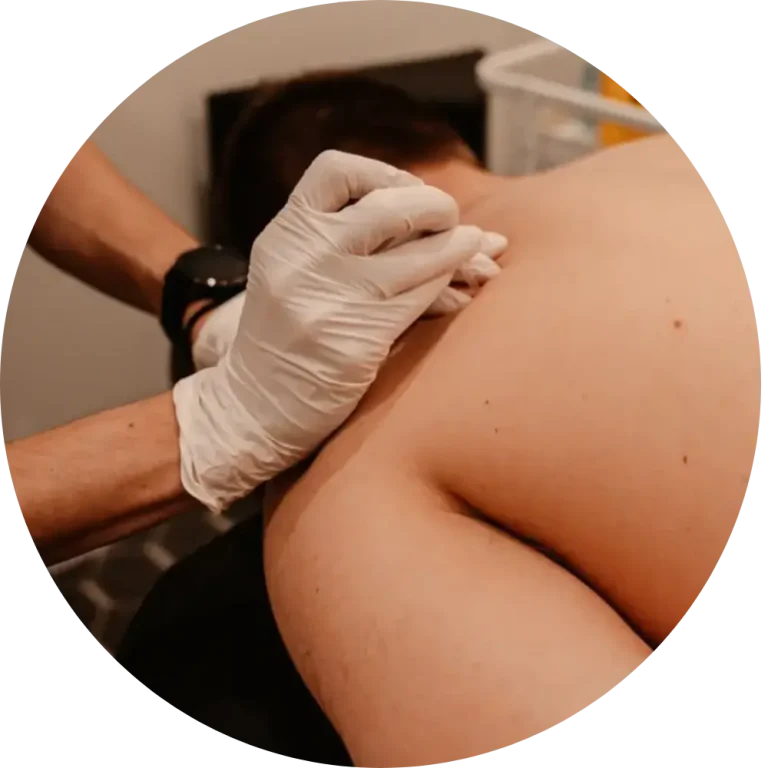
What Is Dry Needling?
Dry needling is a technique used by trained physiotherapists to treat muscle pain, tension, and movement restrictions. It involves inserting a very thin, solid needle — similar in size to an acupuncture needle — directly into a trigger point inside a muscle.
A trigger point is a tight, irritable band of muscle fibre that causes local pain and can also refer pain to other areas of the body. When a needle is inserted into a trigger point, it often produces a brief involuntary “twitch” response. That twitch is a sign the muscle is releasing — and it’s typically followed by a significant reduction in pain and tension.
Dry needling is grounded in Western anatomy and neuroscience. It is performed by regulated physiotherapists, not acupuncturists, and is based on the musculoskeletal and neurological systems rather than traditional Chinese medicine principles.
At Affinity Wellness, dry needling is performed only by physiotherapists who have completed specialized post-graduate training in this technique.
- Headaches and head pressure
- Dizziness and balance problems
- Nausea
- Brain fog and difficulty concentrating
- Memory problems
- Fatigue — especially mental fatigue
- Sleep disturbances
- Sensitivity to light (photophobia)
- Sensitivity to noise (phonophobia)
- Irritability and mood changes
- Anxiety
Most concussion symptoms resolve within 2–4 weeks. However, approximately 10–30% of concussion patients experience symptoms that persist beyond one month — a condition known as post-concussion syndrome (PCS).
What Is the Difference Between Dry Needling and Acupuncture?
This is one of the most common questions patients ask — and it’s a good one.
Both dry needling and acupuncture use thin, solid needles. That’s where the similarity ends.
Acupuncture is a practice rooted in traditional Chinese medicine. It works along a system of meridians and energy pathways to restore balance in the body.
Dry needling is based entirely on Western anatomy and physiology. It targets specific muscles, trigger points, and nerve pathways that have been identified through clinical assessment. The goal is to release tight muscle tissue, reduce pain signals, and restore normal movement patterns.
At Affinity Wellness, our dry needling is performed by registered physiotherapists — not acupuncturists — as part of a broader physiotherapy treatment plan.
What Does Dry Needling Treat?
Dry needling is effective for a wide range of musculoskeletal conditions, particularly those involving chronic muscle tension or stubborn trigger points. Conditions we commonly treat include:
- Chronic neck and back pain
- Tension headaches and cervicogenic headaches
- Migraine headaches
- Shoulder pain and rotator cuff injuries
- Hip pain and gluteal tension
- Knee pain including patellar tendinopathy
- Tennis elbow and golfer’s elbow
- Plantar fasciitis
- Achilles tendinopathy
- Whiplash and motor vehicle accident injuries
- Sciatica and piriformis syndrome
- Carpal tunnel syndrome
- Sports injuries and muscle strains
- Post-surgical scar tissue and muscle guarding
- Chronic pain conditions, including fibromyalgia
If you’re unsure whether dry needling is appropriate for your condition, our physiotherapists are happy to assess you and give you an honest recommendation.
Dry needling at Affinity Wellness is performed by registered physiotherapists who have completed specialized post-graduate training in intramuscular stimulation (IMS) and dry needling techniques.
Not every physiotherapist on our team performs dry needling — it requires additional certification beyond the standard physiotherapy degree. When you book, our reception team will ensure you’re matched with a practitioner who is trained in this technique.
All Affinity physiotherapists are registered with the College of Physical Therapists of BC (CPTBC).

What to Expect During a Dry Needling Session
Many patients are nervous about their first dry needling appointment — which is completely understandable. Here’s exactly what happens.
Before the needle goes in
Your physiotherapist will assess the area, identify the muscles involved, and explain what they’re going to do. You’ll have the opportunity to ask questions and confirm you’re comfortable proceeding.
During the treatment
A very thin, sterile needle is inserted into the targeted muscle. You may feel a mild ache, pressure, or nothing at all as the needle reaches the tissue. When the needle hits a trigger point, you’ll likely feel a brief, involuntary muscle twitch. This is normal and is actually a sign the treatment is working. The twitch is usually followed by an immediate sensation of release in the muscle.
After the treatment
It’s common to feel some muscle soreness for 24–48 hours after dry needling — similar to the feeling after a hard workout. This is a normal healing response. Most patients notice a significant reduction in pain and improvement in movement within 1–3 days of treatment.
How many sessions will you need?
Most patients see meaningful improvement within 3–6 sessions. Acute conditions often respond faster. Chronic or long-standing pain may take longer. Your physiotherapist will give you a realistic timeline at your first assessment.
Is Dry Needling Safe?
Yes. When performed by a trained, registered physiotherapist, dry needling is a safe and well-tolerated treatment. The needles used are single-use, sterile, and disposed of after each session.
As with any treatment, there are some contraindications. Dry needling is generally not recommended for patients who are pregnant, have a needle phobia, take blood thinners, or have certain skin conditions in the treatment area. Your physiotherapist will screen for these before your session.
Dry Needling as Part of a Broader Treatment Plan
Dry needling is rarely used in isolation at Affinity Wellness. It works best as one tool within a broader physiotherapy treatment plan.
A typical session might combine dry needling with manual therapy, targeted exercises, and education about movement patterns or posture. This combined approach tends to produce faster and more lasting results than dry needling alone.
If your physiotherapist also recommends shockwave therapy, the two treatments can complement each other well — shockwave targets tendon and connective tissue, while dry needling targets the muscle itself.
Serving Kelowna and the Okanagan
Affinity Wellness is located at 1890 Ambrosi Rd, Suite 2 in central Kelowna — easy to reach from HWY 97 or Springfield Rd, with free parking at the front and back of the building.
We serve older adults from across the Okanagan Valley including:
- Kelowna and Central Kelowna
- Glenmore and Kelowna North
- Lower Mission and Okanagan Mission
- Rutland and Kelowna East
- West Kelowna and Westbank
- Lake Country
- Peachland
Direct Billing and Insurance
Dry needling performed by a registered physiotherapist is covered by most extended health plans that include physiotherapy coverage. ICBC covers physiotherapy including dry needling for patients recovering from motor vehicle accidents.
Affinity Wellness offers direct billing to most major insurers. You don’t need a separate referral for dry needling — book a physiotherapy appointment and let your physiotherapist know you’re interested in dry needling as part of your treatment.
Dry Needling Kelowna — FAQs
What is dry needling?
Dry needling is a technique performed by trained physiotherapists that uses a thin, solid needle to release trigger points — tight, painful bands of muscle tissue. It reduces pain, relieves muscle tension, and restores movement. At Affinity Wellness, dry needling is performed by registered physiotherapists with specialized post-graduate training.
Is dry needling the same as acupuncture?
No. Both use thin needles, but they are based on different principles. Acupuncture comes from traditional Chinese medicine and targets energy meridians. Dry needling is based on Western anatomy and targets specific muscles and trigger points. At Affinity, dry needling is performed by physiotherapists, not acupuncturists.
Does dry needling hurt?
Most patients feel a mild ache or pressure when the needle enters the muscle. When a trigger point is hit, there is a brief muscle twitch that may feel intense for a second — but is usually followed immediately by a sensation of release. Most patients tolerate dry needling very well and find the results well worth the temporary discomfort.
How many dry needling sessions will I need?
Most patients see meaningful improvement in 3–6 sessions. Acute injuries may respond in fewer sessions. Chronic conditions may require more. Your physiotherapist will give you an honest estimate at your first appointment.
Is dry needling covered by insurance?
Yes, if it is performed by a registered physiotherapist and your extended health plan includes physiotherapy coverage. ICBC also covers physiotherapy including dry needling for motor vehicle accident patients. Affinity Wellness offers direct billing to most major insurers.
Do I need a doctor's referral for dry needling in Kelowna?
No. You can book directly with one of our physiotherapists. Just let the reception team know you’re interested in dry needling and they’ll match you with a trained practitioner.
Who performs dry needling at Affinity Wellness?
Dry needling at Affinity is performed by registered physiotherapists who have completed post-graduate certification in IMS and dry needling. Not all physiotherapists on our team are trained in this technique — our reception team will ensure you’re booked with the right person.
What is the difference between dry needling and IMS?
Intramuscular stimulation (IMS) is a specific system of dry needling developed by Dr. Chan Gunn in Vancouver, BC. IMS is considered a more systematic and comprehensive approach, focusing on the neurological causes of muscle tension. Both IMS and dry needling use the same type of needle and similar techniques — the terms are often used interchangeably in clinical settings.
How do I book a dry needling appointment in Kelowna?
Book online 24/7 through our online booking system, or call (778) 478-0548. Select physiotherapy when booking and note your interest in dry needling. No referral is needed.
General Inquiry
Have a question?
Need More Information on Dry Needling (IMS) in Kelowna?
Ask Our Experienced Team
Affinity Wellness is conveniently located in central Kelowna at 1890 Ambrosi Rd Suite 2, off of either HWY 97 or Springfield Rd. There is FREE PARKING at the front and back of the building.
Contact Us
778-478-0548
info@affinitywellness.ca
Location
Affinity Wellness
1890 Ambrosi Rd Suite 2,
Kelowna, BC V1Y 4R9, Canada
Hours
Monday-Thursday 7:00am – 7:00pm
Friday- 7:00am – 2:30pm
Saturday- 8:00am – 2:00pm
Sunday- Closed