


Written by Dr. Clayton Selles DC, BHKin – Member of the College of Complementary Health Professions of BC
What Is the “Cracking” Noise in Chiropractic Adjustments And Is It Safe?
Many people are concerned, worried, or even nervous about “cracking” their spine, especially their neck. This is one of the most common questions I hear in clinical practice, and understandably so. The sound can seem alarming if you’re not familiar with what’s actually happening inside the body.
The good news is that this phenomenon is well understood, and current evidence helps reassure us that it is both normal and safe.
👉 Looking for chiropractic care in Kelowna? Learn more about our Chiropractic Services or Book Online.
 What Is the Cracking Noise?
While it may sound concerning, the “cracking” noise is not bones grinding or anything being damaged. In reality, it is simply the release of gas within the joint.
Our joints contain a fluid called synovial fluid, which acts as a lubricant to allow smooth, pain-free movement. When a joint is stretched, either during normal movement or a chiropractic adjustment, the pressure inside the joint changes. This leads to the rapid formation of a small gas-filled cavity within the fluid, which produces the audible “pop” or “crack.”
This process has been directly visualized in medical research. In a published study done by the University of Alberta, researchers used real-time MRI imaging to observe what happens during joint cracking. They found that the sound is associated with the rapid creation of a gas-filled cavity within the synovial fluid and it occurs as the joint surfaces separate.
As described by the lead researcher, it is “a little bit like forming a vacuum”—as the joint space increases, fluid cannot fill the space quickly enough, and a cavity forms. That cavity is what creates the sound.
What Happens During a Chiropractic Adjustment?
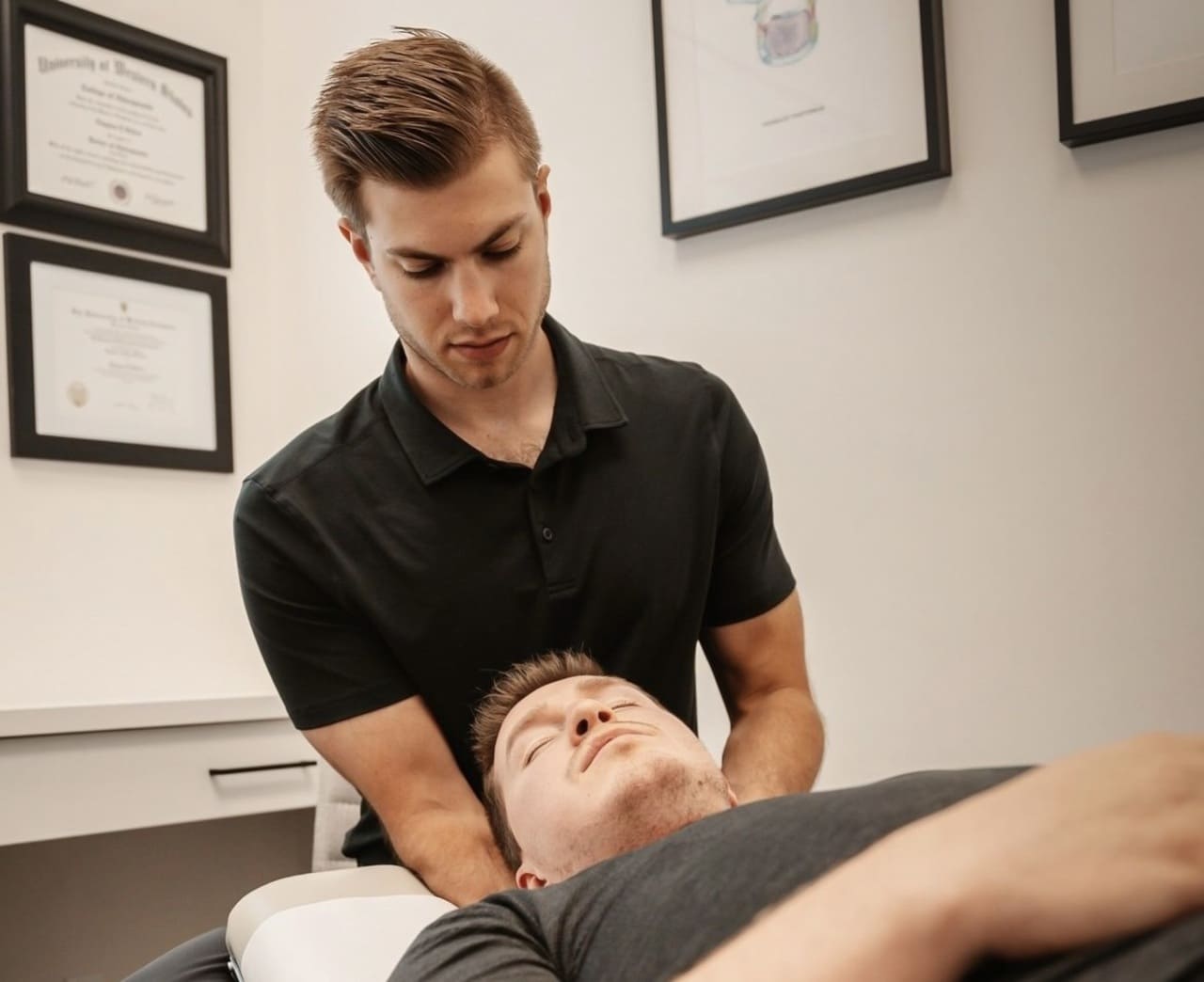
When chiropractors perform spinal manipulations (also known as adjustments), they apply a controlled force to a joint in order to improve its movement.
This stretching of the joint can create the same cavitation effect observed in the UofA research. If a “crack” occurs, it simply indicates that the joint has moved and a pressure change has taken place.
The primary goal of these adjustments is not to create a sound, but to improve joint mobility. Improved motion in the joints can help reduce stiffness, restore normal movement patterns, and contribute to symptom relief.
Does a Joint Need to Crack to Be Effective?
An important point that is often misunderstood is that not all adjustments result in a cracking sound and that’s completely normal.
In fact, there is no clear evidence that cavitation (the cracking sound) is required for a therapeutic effect. Whether or not a joint “cracks,” spinal manipulation can still improve range of motion and provide clinical benefit.
In other words, the effectiveness of treatment is not dependent on the sound itself.
Does Cracking Joints Cause Arthritis?
Another very common concern is whether cracking joints, either intentionally or during treatment, can lead to arthritis.
The short answer is no.
One well-known example comes from a physician who conducted a long-term personal experiment. He cracked the knuckles of one hand for over 50 years while leaving the other hand untouched. At the end of the study period, there was no difference between the two hands in terms of arthritis or function.
More broadly, current research does not support a link between joint cracking and the development of arthritis.
Is Chiropractic Care Safe in Kelowna?
If you’ve ever considered chiropractic treatment, it’s completely natural to have questions, especially when it comes to safety. One of the most common concerns I hear relates to neck adjustments and whether they can increase the risk of serious conditions like stroke.
Let’s take a closer look at what the research actually tells us.
Understanding the Concern
There has been a long-standing theory suggesting that neck manipulation could lead to a condition called cervical artery dissection (CAD). This theory proposes that an adjustment could cause a small tear in one of the arteries in the neck, leading to a blood clot that may travel to the brain and result in a stroke.
While this idea sounds concerning, it’s important to emphasize that it has been extensively studied and the current evidence does not support this as a cause-and-effect relationship.
What the Research Shows
One of the largest and most well-known studies on this topic, conducted by J. David Cassidy and colleagues, examined the risk of stroke following visits to both chiropractors and medical doctors.
The key finding was clear:
- There was no difference in the risk of cervical artery dissection or stroke between patients who visited a chiropractor and those who visited a primary care physician.
Why is this important?
Because it suggests that chiropractic care is not the cause of these events.
- Cassidy, J. D., Boyle, E., Côté, P., He, Y., Hogg-Johnson, S., Silver, F. L., & Bondy, S. J. (2008). Risk of vertebrobasilar stroke and chiropractic care: Results of a population-based case-control and case-crossover study. Spine, 33(4 Suppl), S176–S183. https://doi.org/10.1097/BRS.0b013e3181644600
What’s Actually Happening?
The most common early symptoms of cervical artery dissection include:
- Neck pain
- Headaches
These symptoms often lead individuals to seek care, whether from a chiropractor or a medical doctor.
In some cases, the dissection is already in progress, but not yet diagnosed. The visit to a healthcare provider happens because of the symptoms, not because the provider caused the condition.
This is a critical distinction.
Research consistently shows that the apparent association between chiropractic visits and CAD is explained by this sequence of events, not by the treatment itself.
How Common Is CAD?
It’s also important to understand how rare this condition is.
Cervical artery dissection occurs at a rate of approximately 2.6 cases per 100,000 people per year in the general population.
This means it is an extremely uncommon event, regardless of whether someone seeks chiropractic care or not.
- Lee VH, Brown RD Jr, Mandrekar JN, Mokri B. Incidence and outcome of cervical artery dissection: a population-based study. Neurology. 2006 Nov 28;67(10):1809-12. doi: 10.1212/01.wnl.0000244486.30455.71. PMID: 17130413.
What Does the Research Say?
High-quality reviews of the available evidence reinforce this conclusion.
“There is no convincing evidence to support a causal link between chiropractic manipulation and cervical artery dissection.”
“Observed associations are likely due to bias and confounding, particularly the link between neck pain and CAD”
- Church EW, Sieg EP, Zalatimo O, Hussain NS, Glantz M, Harbaugh RE. Systematic Review and Meta-analysis of Chiropractic Care and Cervical Artery Dissection: No Evidence for Causation. Cureus. 2016 Feb 16;8(2):e498. doi: 10.7759/cureus.498. PMID: 27014532; PMCID: PMC4794386.
“There is no convincing evidence that spinal manipulation causes CAD”
- Brown, S., and Lehman, JJ., 2025. Can Cervical Spine Manipulation Cause Immediate Thromboembolic Stroke? Medical Research Archives, [online] 13(11). https://doi.org/10.18103/mra.v13i11.7091
“Patients with early CAD symptoms are simply more likely to seek care”
- Thistle, S. Research Review: Systematic Review and Meta-Analysis of Chiropractic Care and Cervical Artery Dissection: No Evidence for Causation
What This Means for You
Based on the best available evidence, chiropractic care, when performed by a trained professional, is considered a safe and appropriate treatment option for many musculoskeletal conditions.
Most importantly:
- Chiropractic adjustments do not increase your risk of stroke
- The risk level is the same as visiting a medical doctor
- Reported associations are explained by pre-existing symptoms, not the treatment
👉 Still have questions? Our team is here to help you feel confident before your first visit.